Tilt Wireless Hydrometer and Thermometer for Fermentation Review (2026)
Updated September 14, 2026 · Research-based review
Our verdict
The Tilt floats in your fermenter and sends gravity and temperature to a phone app over Bluetooth, accurate to plus or minus 0.002 gravity and 1 F. That means checking fermentation without opening the vessel, at a real cost premium over a manual hydrometer. Our score of 8.1 out of 10 places it third here.
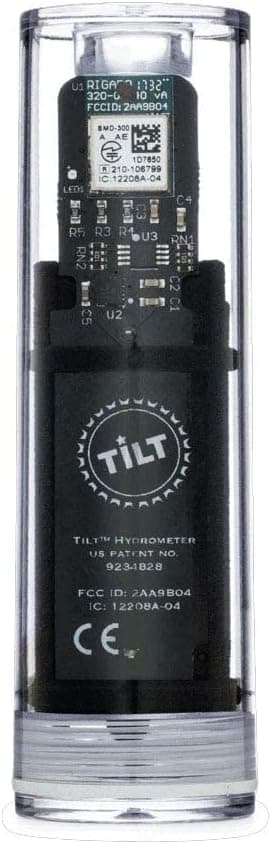
Tilt wireless hydrometer and thermometer that floats in the fermenter and sends gravity and temperature to your phone.
Price range: $ (Budget)
What we liked
- + Tracks gravity and temperature continuously without opening the fermenter
- + Bluetooth data lets you see fermentation progress from a phone
- + Reduces infection risk from repeated sampling
Trade-offs
- - Much more expensive than a standard glass thermometer
- - Signal can struggle through stainless fermenters or fridges
Who the Tilt is built for
The Tilt suits brewers who want to watch fermentation progress without repeatedly opening the fermenter, whether that is out of concern for contamination risk or simple curiosity about how a batch is coming along. It is a natural fit for anyone already comfortable with a smartphone app managing brewing data, since the device is essentially useless without pairing it to the free Tilt app or a Tilt Pi setup. Homebrewers running multiple simultaneous fermentations can use different colored Tilt units to track several batches at once through the same app. Beginners on a tight budget, or anyone who only wants an occasional gravity check rather than continuous logging, will likely find a traditional glass hydrometer and a simple thermometer does the same core job for meaningfully less money.
How it works and what the specs mean
The Tilt floats inside the fermenter and uses its angle in the liquid to calculate specific gravity, transmitting readings over Bluetooth to a paired phone, tablet or Tilt Pi device rather than requiring a wired connection. Its pre-calibrated gravity range runs from about 0.990 to 1.120, extendable to 1.200 with user calibration, accurate to plus or minus 0.002 within that range, which is precise enough for tracking fermentation trends in beer, wine, cider or mead. Temperature accuracy is rated at plus or minus 1 degree Fahrenheit, giving a reasonable secondary read on fermentation conditions alongside gravity. It runs on a single user-replaceable CR123A lithium battery rated for roughly 12 to 24 months depending on how often it transmits, and it requires a Bluetooth 4.0 or newer device to pair with the free companion app available on iOS and Android.
Living with the Tilt day to day
Sanitize the Tilt the same way you would any other equipment that goes into the fermenter before dropping it in with your beer, wine or mead, since it stays submerged for the full fermentation period. Once paired, the app logs gravity and temperature readings automatically, letting you watch fermentation activity slow and eventually plateau without lifting the lid or airlock, which reduces contamination risk compared with pulling manual samples. Wireless range is rated at up to 300 feet floating in a glass of water but drops to around 20 feet when floating inside a stainless steel keg or conical fermenter, since metal interferes with the Bluetooth signal, so keep your phone or Tilt Pi reasonably close if you are fermenting in steel. Because it depends on a battery and Bluetooth connection, it is worth having a backup manual hydrometer on hand in case the Tilt loses connection or the battery runs low mid-fermentation.
How it compares to simpler brewing thermometers
In the site's brewing thermometers guide, the Tilt ranks third behind two nearly identical 12 inch stainless dial thermometers from Home Brew Ohio and HomeBrewStuff, both scoring 8.4 by offering simple, no-battery kettle-side readings for a fraction of the cost. What the Tilt offers that those dial thermometers cannot is continuous, hands-off tracking through an entire multi-day fermentation without ever opening the vessel, a genuinely different use case from checking boil or mash temperature. Compared with the Craft A Brew 9 inch glass floating thermometer at 7.6, which gives a simple visual temperature read with no gravity data or app involved, the Tilt trades simplicity for far more information delivered automatically. The right choice depends on whether you need kettle-side temperature monitoring, which the dial thermometers handle well and cheaply, or ongoing fermentation tracking, which is the Tilt's specific strength.
Verdict and who should pick something else
Choose the Tilt if you want to track both gravity and temperature throughout fermentation without repeatedly sampling or opening the vessel, and you are comfortable relying on a Bluetooth connection and phone app to get your readings. It earns a solid third-place score in this guide for the genuinely useful continuous data it provides, even though it costs meaningfully more than a simple dial or glass thermometer. If you only need to check kettle or mash temperature during the brew day itself, the Home Brew Ohio or HomeBrewStuff 12 inch dial thermometers do that job more simply and without a battery to manage. Brewers who prefer manual sampling with a traditional hydrometer and are not interested in app-based logging can skip the Tilt and save the cost difference for other equipment.
Frequently asked questions
What is the gravity measurement range and accuracy?
The Tilt is pre-calibrated to read specific gravity from about 0.990 to 1.120, extendable to 1.200 with user calibration, at an accuracy of plus or minus 0.002 within that range.
How long does the battery last?
It uses a single user-replaceable CR123A lithium battery rated for roughly 12 to 24 months depending on how often the device transmits readings.
Does the Tilt work through a stainless steel fermenter or keg?
Yes, but wireless range drops to around 20 feet floating inside a stainless steel vessel compared with up to 300 feet in open air, since metal interferes with the Bluetooth signal, so keep your receiving device nearby.
Do I need a smartphone to use it?
You need a Bluetooth 4.0 or newer smartphone or tablet running the free Tilt app, or alternatively a Tilt Pi device, since the Tilt itself has no display and relies on a paired device to show readings.
Prices change often, so check the current price and availability on Amazon.
Check price on AmazonHome Brew Craft may earn a commission from the link above.